
The information provided in this article is for general guidance and health awareness only and does not substitute for professional medical advice.
- Never attempt to remove whiteheads by squeezing or scratching with your nails, as this increases inflammation and leaves permanent scars.
- Consult a dermatologist if whiteheads are very numerous, painful, inflamed, or do not respond to home treatments after 6-8 weeks.
- For pregnant and breastfeeding women: Please be cautious when using any products containing salicylic acid or retinoids, and consult a doctor first.
Does Your Face Look Like It's Sprinkled with Little White Dots?
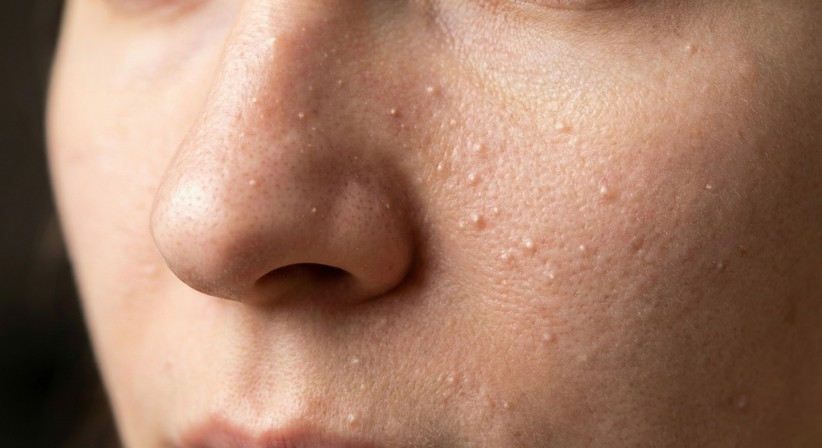
You look closely in the mirror, and you notice those small, white, hard bumps scattered on your nose, chin, or maybe your forehead. They aren't red, and they aren't inflamed like big pimples, but they are... there, ruining your skin's smooth texture and making it look "bumpy" under makeup.
These, my dear, are "Whiteheads," and they are one of the most common forms of acne, but also the most "sneaky." You might think they'll disappear on their own if you ignore them, but they often decide to stay for a long time, or worse, turn into inflamed pimples if you mess with them the wrong way.
In this article, we will unveil the truth about these little dots: Why do they choose your beautiful face to dwell in? And how can you evict them gently and effectively without leaving a trace? Get ready to reclaim your skin's smoothness!
What Are Whiteheads Anyway? (And Why Are They Different from Blackheads?)
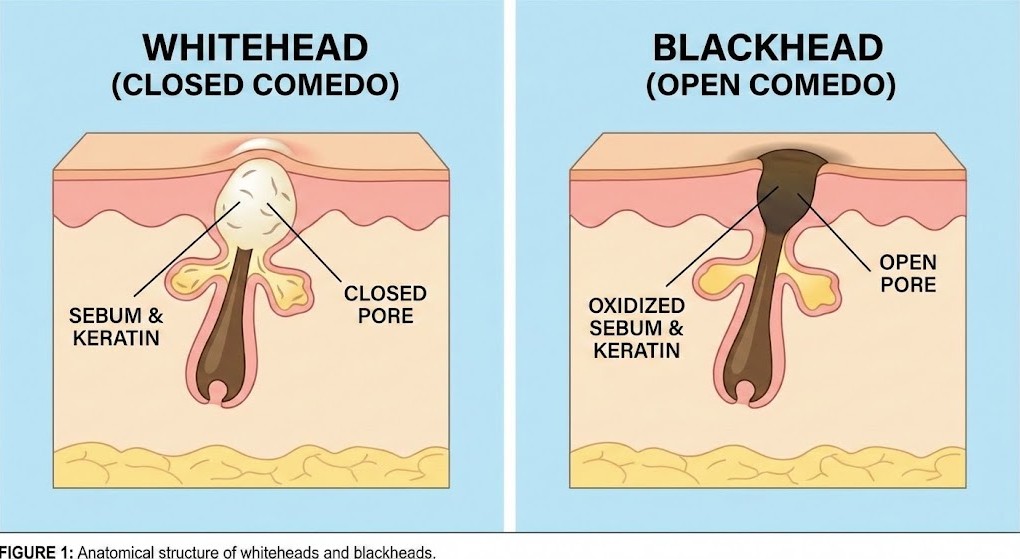
Whiteheads are simply clogged pores scientifically known as Closed Comedones [1]. Imagine your skin pore is a small pit. When this pit gets filled with a "sticky" mixture of natural oils (sebum) and dead skin cells, and then the mouth of the pit gets closed by a thin layer of skin, a whitehead is formed.
The fundamental difference between them and blackheads? It lies in the extent to which the blockage is exposed to air:
- Whiteheads (Closed Comedones): The pore is completely closed, so the mixture inside isn't exposed to air and remains white or skin-colored.
- Blackheads (Open Comedones): The pore is open, so the mixture is exposed to air and oxidizes (just like a cut apple turns black), turning it black.
Why Do They Appear Specifically on You? (Scientific Reasons)
The appearance of whiteheads is not random; it's the result of several interacting factors [2]:
- Overactive Sebaceous Glands: Hormones (especially androgens during puberty and menstruation) stimulate sebaceous glands to produce excessive amounts of sebum, which is the "fuel" for whiteheads.
- Hyperkeratinization: The abnormal accumulation of dead skin cells within hair follicles, leading to their blockage.
- Bacteria (P. acnes): Natural bacteria present on the skin can multiply in the blocked environment and cause inflammation.
- Comedogenic Skincare and Makeup Products: Some oils and ingredients in makeup and moisturizing creams clog pores. Look for "non-comedogenic" on the label.
- Friction and Pressure: Such as repeated face touching or friction from tight clothing.
Attack Strategy: How Do We Get Rid of Them? (Approved Treatments)
Getting rid of whiteheads requires patience and the right ingredients, avoiding squeezing or scratching [3].
1. Salicylic Acid - Your New Hero
This ingredient is a Beta Hydroxy Acid (BHA) that is oil-soluble, making it ideal for penetrating oily pores.
- Mechanism of Action: It penetrates hardened sebum, dissolves the "glue" that holds dead skin cells together, thereby opening and cleansing the pores from within.
- How to use it? Look for a face wash, toner, or serum with 0.5% to 2% salicylic acid. Use once daily initially, then twice if your skin tolerates it.
2. Topical Retinoids - The Radical Solution
Retinoids (like Adapalene) are Vitamin A derivatives.
- Mechanism of Action: They work by speeding up the rate of skin cell turnover, preventing dead skin cells from accumulating and blocking pores in the first place. They also reduce inflammation.
- Tip: Start slowly (twice a week at night) as they might cause dryness and irritation initially. Sunscreen is absolutely essential when using them.
3. Gentle Steam Facial and Deep Cleansing
- Steam: Warm steam helps to soften sebum and temporarily open pores, making the cleansing process easier.
- Professional Extraction: In some cases, a dermatologist or skincare professional may perform a safe, manual extraction using sterile tools. Never attempt this yourself!
Prevention: How to Ensure They Don't Come Back?
Maintaining clear skin free from whiteheads requires a consistent routine [4]:
- Regular Cleansing and Exfoliation Routine:
- Cleanse your face twice daily (morning and evening) with a gentle, sulfate-free cleanser.
- Use a chemical exfoliant (like salicylic acid or glycolic acid) 2-3 times a week.
- Smart Moisturizing: Choose a lightweight, oil-free "Gel Moisturizer" labeled "Non-comedogenic."
- Review Makeup Products: Ensure your makeup and sunscreen are non-comedogenic.
- Continuous Hygiene:
- Change pillowcases regularly (at least twice a week).
- Wipe your phone screen daily.
- Wash your hair regularly and keep it away from your face as much as possible.
- Avoid Face Touching: As mentioned in the previous article, hands transfer bacteria and oils.
When to See a Doctor? (Warning Signs)
If whiteheads are:
- Very numerous, cover a large area, and do not respond to home treatments after 6-8 weeks.
- Cause severe inflammation or pain.
- Leave scars or dark spots. In these cases, a dermatologist may prescribe stronger treatments such as topical or oral retinoids, antibiotics, or recommend in-office procedures.
A "Smooth" Conclusion
Whiteheads can be stubborn, but they are not impossible to treat. With the right knowledge, proper routine, and a little patience, you can control them and regain your skin's smoothness and radiance. Always remember that consistency and gentleness with your skin are key.
Scientific Sources and References
- American Academy of Dermatology Association (AAD). "What causes acne?"
- Leyden, J. J., et al. (2017). "Acne vulgaris: Pathogenesis and treatment." Journal of the American Academy of Dermatology, 76(2), S1-S14.
- Zaenglein, A. L., et al. (2016). "Guidelines of care for the management of acne vulgaris." Journal of the American Academy of Dermatology, 74(5), 945-973.
- Tanghetti, E. A. (2013). "The role of inflammation in the pathology of acne." Journal of Clinical and Aesthetic Dermatology, 6(9), 27-35.
Note: Images used are for illustrative purposes only.