
The information provided in this article is for general guidance and health awareness only and does not substitute for professional medical advice.
- High concentrations of Vitamin C may cause irritation to sensitive or eczema-prone skin. Please perform a patch test before use.
- For pregnant and breastfeeding women: Topical Vitamin C is generally considered safe, but consulting a doctor to determine the appropriate concentration is recommended.
The Battle with Pimples is Over, But Has the War with Scars Begun?
You did it! After weeks of care and patience, that big pimple that was bothering you is gone. You breathed a sigh of relief and ran to the mirror to celebrate clear skin, but... wait. What is that dark brown mark the pimple left behind?
It's the classic scenario we all go through: the pimple leaves, but it leaves a small "souvenir" that refuses to go. These dark spots, or what dermatologists call Post-Inflammatory Hyperpigmentation (PIH), can sometimes be more annoying and stubborn than the acne itself.
But don't be sad, my dear, for the solution exists, and it's not magic or a strange secret mixture. It's a real superhero in the skincare world, a single ingredient that studies and results have proven to be the "eraser" you need for these marks. Welcome with me Vitamin C.
Not Just a Vitamin for Colds... It's Your Skin's Restoration Engineer!
When you hear "Vitamin C," you probably think of orange juice and immunity. But for your skin, this vitamin performs amazing heroic roles, backed by science:
1. The Pigmentation Vanquisher (How does it work scientifically?)
The secret lies in an enzyme called Tyrosinase. This enzyme is responsible for stimulating melanin cells to produce brown pigment when inflammation occurs. Vitamin C acts as a potent inhibitor of this enzyme [1]. Simply put, it cuts off the path for excess melanin production, gradually leading to the lightening of dark spots and evening out of skin tone.
2. The Collagen Factory
Do you have those slightly indented scars or small "pits" (Atrophic Scars)? Vitamin C is an essential cofactor for enzymes building collagen in the skin. Increased collagen means plumper and stronger skin, which helps in "filling" those gaps and repairing the skin from the inside [2].

3. The Protective Shield (Antioxidant)
Your skin is under daily attack from "Free Radicals" resulting from sun and pollution. These molecules destroy cells and delay healing. Vitamin C donates an electron to these free radicals to neutralize them, protecting your healthy skin cells and accelerating the healing process.
How to Choose the Right "Serum"? (Your Pharmacy Guide)
Stood in front of the skincare shelves feeling lost? Here is the "code" to crack the mystery of the right choice:
| Derivative Type | Features | Suitable For |
|---|---|---|
| L-Ascorbic Acid | Strongest and most effective, fast results | Normal and combination skin (may irritate sensitive) |
| Sodium Ascorbyl Phosphate | Gentler, more stable, has anti-bacterial properties | Sensitive and acne-prone skin |
| Magnesium Ascorbyl Phosphate | Moisturizing and very gentle | Dry and sensitive skin |
The Ideal Concentration: Studies indicate that efficacy starts from a concentration of 10% and peaks at 20%. Any concentration higher than 20% will not increase efficacy but will only increase irritation [1].
Your New Routine Step-by-Step
Morning is its Golden Time: Although you can use it at night, using it in the morning gives you double the benefit because it enhances the effectiveness of your sunscreen.
- Cleansing: Wash your face with a gentle cleanser and dry it gently.
- Vitamin C: Apply 3-4 drops of the serum to your face. Distribute gently.
- Moisturizing: Apply your regular moisturizer.
- Sunscreen (Mandatory!): Vitamin C gently exfoliates the skin (Micro-exfoliation), making new cells sensitive to the sun.
When Will I See Results? (A Call for Patience)
My dear, skincare is a marathon, not a sprint. The skin cell turnover cycle takes about 28 days.
- Radiance: Immediate or within a week.
- Spot Lightening: Requires 8 to 12 weeks of consistent use.
Scientific Sources and References
- Telang, P. S. (2013). "Vitamin C in dermatology." Indian Dermatology Online Journal.
- Pullar, J. M., et al. (2017). "The roles of vitamin C in skin health." Nutrients.
- Al-Niaimi, F., & Chiang, N. (2017). "Topical Vitamin C and the Skin: Mechanisms of Action and Clinical Applications." Journal of Clinical and Aesthetic Dermatology.
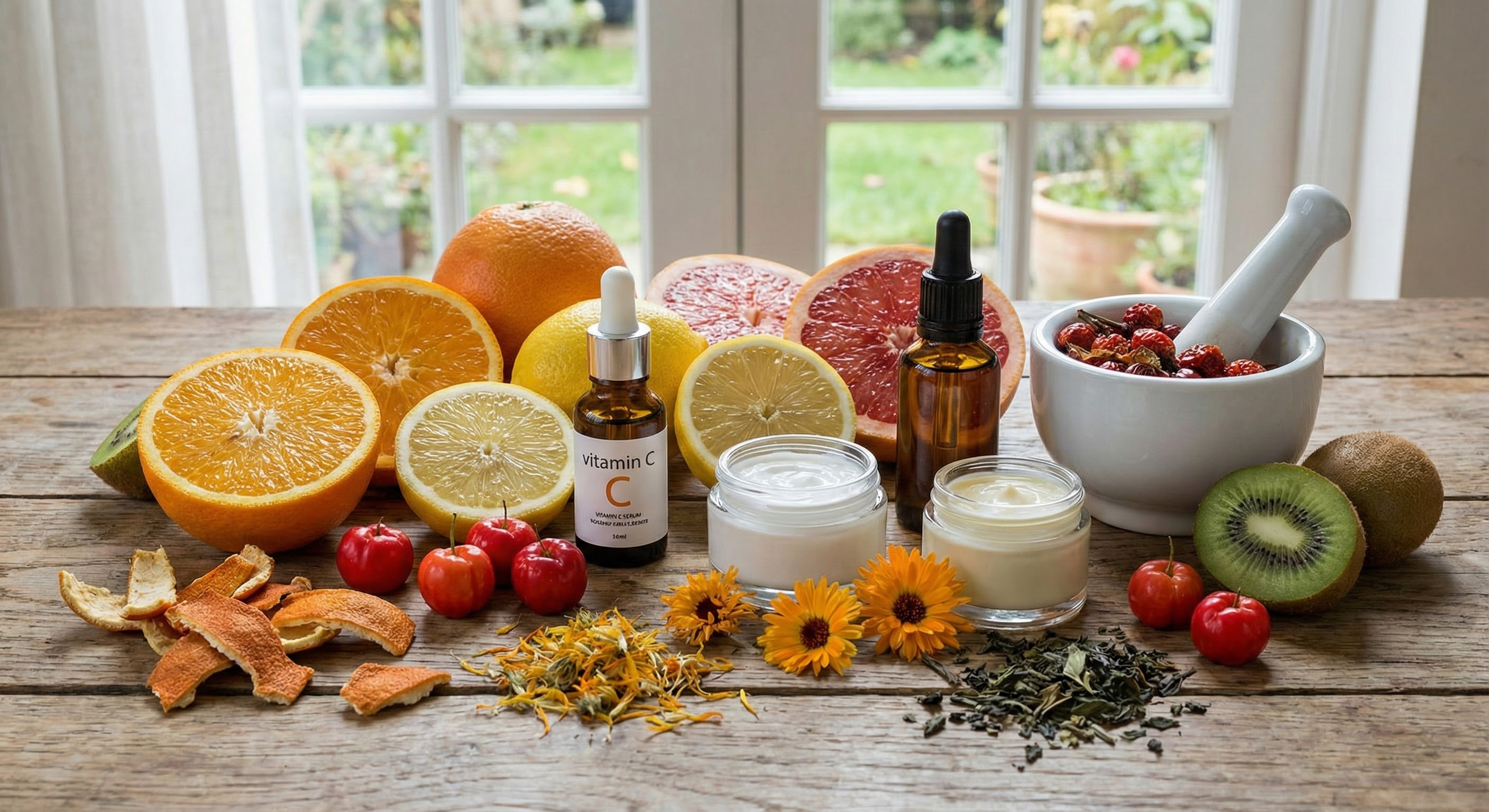
Note: Images used are for illustrative purposes only.