
The information provided in this article is for general guidance and health awareness only and does not substitute for professional medical advice.
- Consult a dermatologist immediately in severe cases (cystic acne), if scarring occurs, or if there is no improvement after 6-8 weeks of home care.
- For pregnant and breastfeeding women: Please be cautious when using topical products (such as retinoids) and consult a doctor first to ensure safety.
Let's Be Real... We're All Guilty
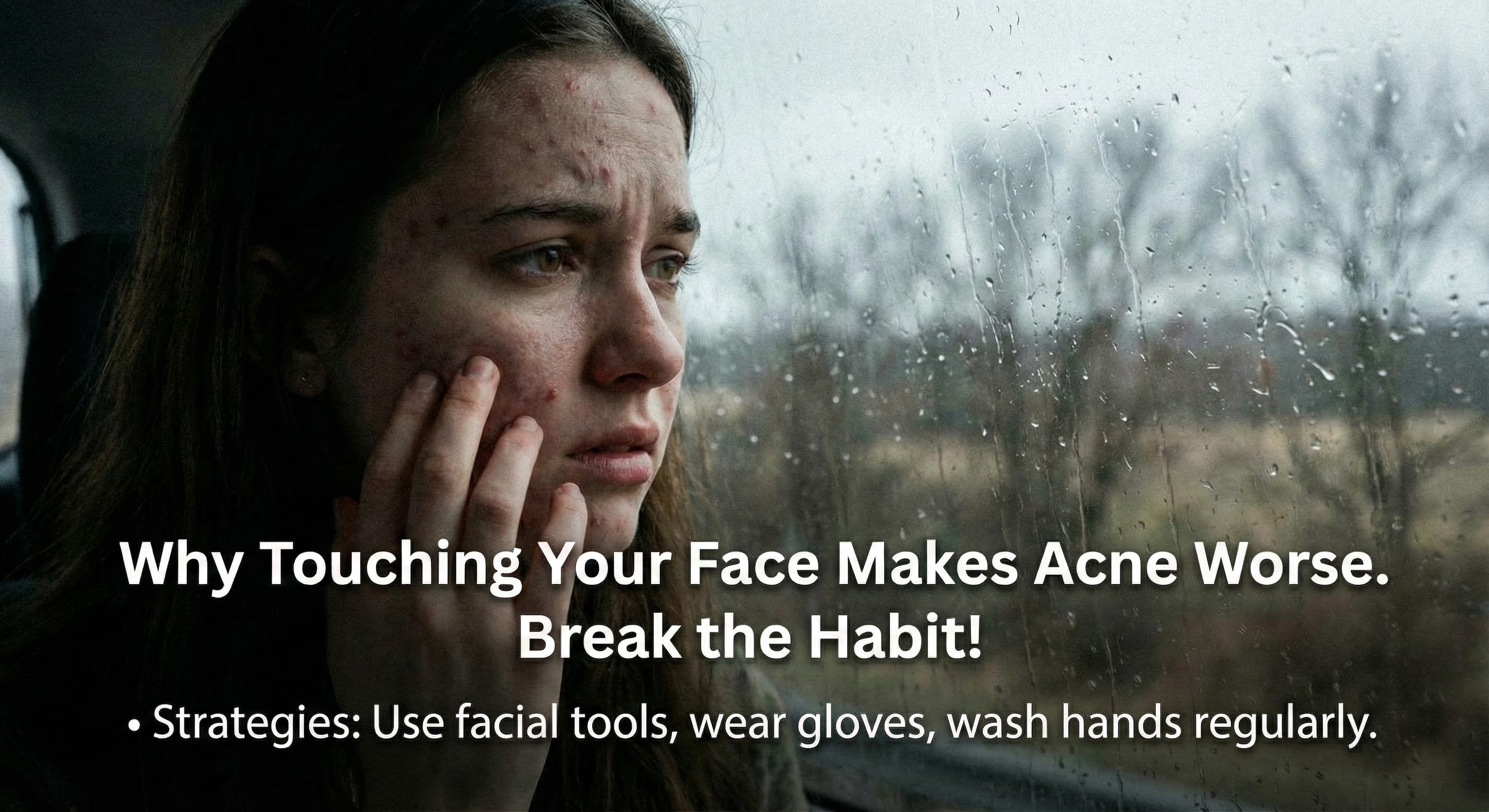
Picture this scenario: You're sitting at your desk, trying to solve that complex math problem, or maybe watching your favorite show with intense focus. Without even realizing it, your hand slowly sneaks up to rest on your cheek, or maybe your finger starts fiddling with that little spot on your chin. It feels comforting, right? It's a completely involuntary action.
But here is the medical truth: Studies indicate that people touch their faces approximately 23 times per hour [1]. This simple act might be the hidden reason why acne persists, or what is scientifically known as "Acne Mechanica."
Why Are Your Hands a "VIP" Transport for Bacteria?
Your hands might look clean, but they are a breeding ground for microorganisms.
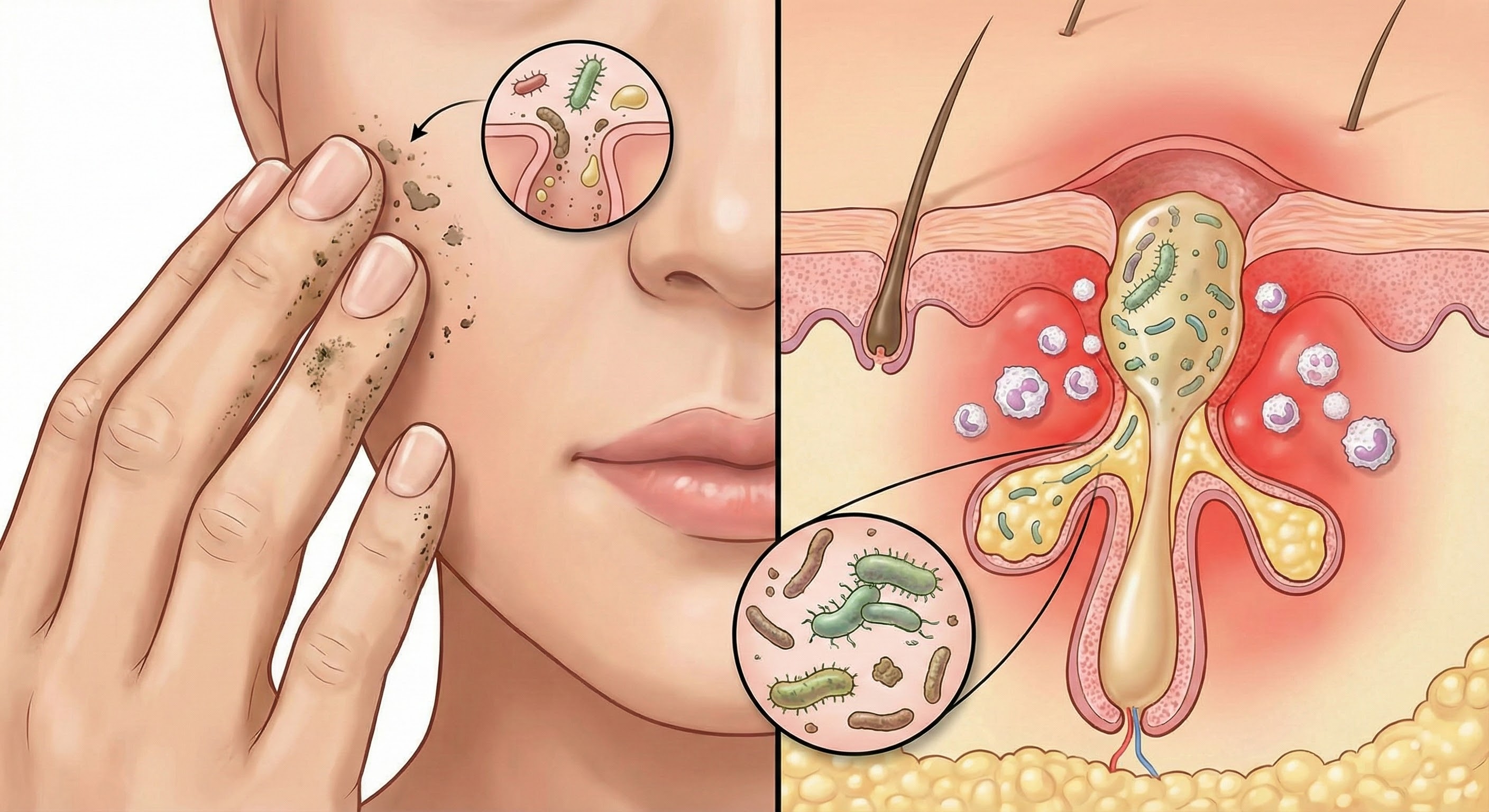
- Bacteria Transfer: Acne-causing bacteria (C. acnes) can be transferred or multiply thanks to the oils and dirt you transfer from various surfaces (phones, keyboards) to your face.
- Friction and Inflammation: Constant pressure causes mechanical irritation to the skin, stimulating inflammation and increasing the likelihood of clogged pores.
Why Do We Do It Anyway? (The Psychological Side)
Touching the face isn't just a physical habit; it's connected to our psychological state:
- Self-Soothing: A way to relieve stress and anxiety.
- Boredom and Focus: A motor reaction during deep thinking.
- Compulsive Checking (Skin Picking): Searching for blemishes and trying to remove them, which can develop into a condition requiring behavioral intervention if excessive.
The Action Plan: Strategies to Break the Habit
Here is a table showing the difference between negative habits and healthy alternatives:
| Negative Habit (Avoid) ❌ | Healthy Alternative (Try) ✅ | Expected Effect |
|---|---|---|
| Resting chin on hand while studying | Use a Stress Ball or play with a pen | Reduce friction and prevent "Acne Mechanica" |
| Feeling face for pimples | Apply "Pimple Patches" on pimples | Create a physical barrier preventing tampering |
| "Popping" pimples by hand | Use spot treatments (like Benzoyl Peroxide) | Treat inflammation without leaving permanent scars |
What If the Pimple Appears... Should I Touch It Now?
The definitive medical answer is: No. Trying to "pop" a pimple leads to:
- Pushing bacteria and pus into deeper layers of the dermis.
- Increasing the risk of Post-Inflammatory Hyperpigmentation (PIH) and permanent scarring.
When is Medical Intervention Needed? If you suffer from large, hard, painful cysts under the skin that do not respond to general advice, this may require:
- Intralesional Steroid Injection at a doctor's office.
- Oral medications (antibiotics or isotretinoin) under strict medical supervision.
Scientific Sources and References
To ensure accuracy, the following sources were referenced:
- Kwok, Y. L. A., et al. (2015). "Face touching: A frequent habit that has implications for hand hygiene." American Journal of Infection Control.
- American Academy of Dermatology Association (AAD). "Pimple popping: Why only a dermatologist should do it."
- Tanghetti, E. A. (2013). "The role of inflammation in the pathology of acne." Journal of Clinical and Aesthetic Dermatology.
Note: Images used are for illustrative purposes only.